

If you've been thinking about selling your home, you've probably noticed something confusing: the national real estate headlines don't quite match what you're seeing in Colorado Springs.
You may have heard that homes are still selling quickly and prices are holding firm across the country. But when you look at listings in your neighborhood, you see price cuts and homes sitting longer than expected. Here's what's happening: El Paso County is tracking national trends more closely than you might think—but with some important local differences.
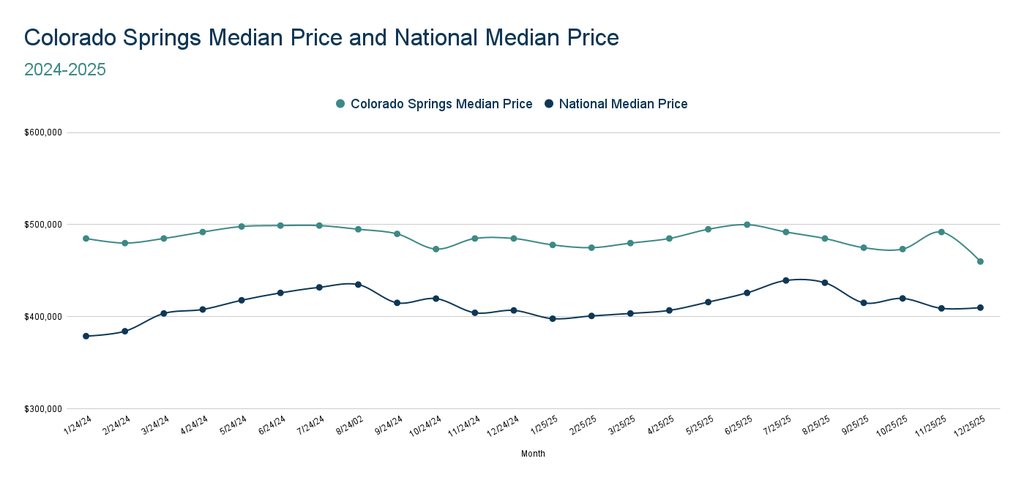
Nationally, the housing market has shifted to a balanced market, favoring neither buyers nor sellers. El Paso County maintains a slightly tighter market position:
 According to realtor.com's September 2025 study, the week of October 12-18 offered buyers a rare "trifecta": 33% more active listings, prices 3.4% below seasonal peaks (about $15,000 in savings), and 31% less competition than peak season.
If fall became the best time for buyers, what does that say about spring for sellers? The traditional advantage—more buyers creating competition and driving prices—has been diluted by an overwhelming surge in inventory. Buyers now shop when they want, not when sellers need them to.
This buyer advantage in fall reveals an important truth for sellers in 2026: the old seasonal rules no longer apply.
According to realtor.com's September 2025 study, the week of October 12-18 offered buyers a rare "trifecta": 33% more active listings, prices 3.4% below seasonal peaks (about $15,000 in savings), and 31% less competition than peak season.
If fall became the best time for buyers, what does that say about spring for sellers? The traditional advantage—more buyers creating competition and driving prices—has been diluted by an overwhelming surge in inventory. Buyers now shop when they want, not when sellers need them to.
This buyer advantage in fall reveals an important truth for sellers in 2026: the old seasonal rules no longer apply.
 Peak season still means more buyers—but in 2026, it also means dramatically more seller competition. Last year's Q2 brought a significant inventory surge in Colorado Springs, and by early summer, sellers were competing through either exceptional condition or aggressive pricing just to get noticed.
Here's the paradox: when everyone follows the same "list in spring" conventional wisdom, competitive edge disappears. Would you rather be one of 2,819 homes on the market right now in January, or one of 4,500+ properties competing in May?
Peak season still means more buyers—but in 2026, it also means dramatically more seller competition. Last year's Q2 brought a significant inventory surge in Colorado Springs, and by early summer, sellers were competing through either exceptional condition or aggressive pricing just to get noticed.
Here's the paradox: when everyone follows the same "list in spring" conventional wisdom, competitive edge disappears. Would you rather be one of 2,819 homes on the market right now in January, or one of 4,500+ properties competing in May?
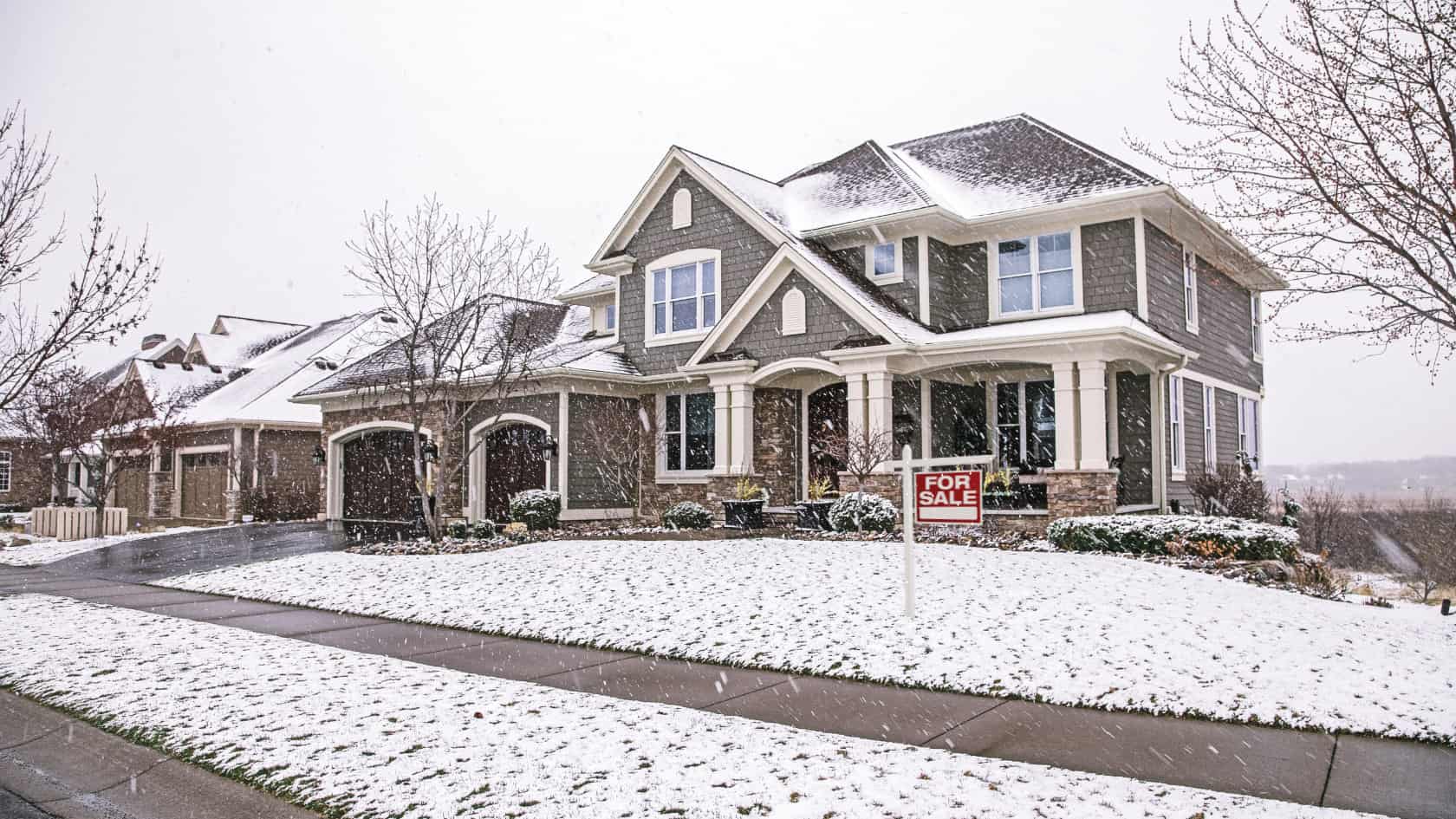 Selling your house in winter 2026—or even early spring before the rush—may actually be strategically better than waiting for peak season. Here's why the data supports it.
Serious buyers only. Winter and early-year buyers aren't casually browsing—they're motivated by job relocations, military transfers, or financial deadlines. Higher mortgage rates continue to filter out marginal shoppers, leaving committed buyers with genuine reasons to purchase now. These aren't window shoppers braving cold weather for fun—they mean business.
Less competition, more attention. While buyer traffic is lighter right now, so are competing listings—and in this market, that matters more. With fewer homes available, your property gets more attention and serious offers rather than getting lost in the coming spring surge.
Better positioning. You're not competing with dozens of similar properties to be the best deal. Recent sales data shows that well-priced homes are still moving—suggesting motivated buyers are active year-round, not just during peak season.
Showcase your home's warmth. Winter lets you create atmosphere that spring can't match. Strategic lighting, cozy staging, and highlighting energy-efficient features help buyers imagine life inside during Colorado's cold months—a powerful emotional advantage when they're looking for sanctuary from the weather.
Selling your house in winter 2026—or even early spring before the rush—may actually be strategically better than waiting for peak season. Here's why the data supports it.
Serious buyers only. Winter and early-year buyers aren't casually browsing—they're motivated by job relocations, military transfers, or financial deadlines. Higher mortgage rates continue to filter out marginal shoppers, leaving committed buyers with genuine reasons to purchase now. These aren't window shoppers braving cold weather for fun—they mean business.
Less competition, more attention. While buyer traffic is lighter right now, so are competing listings—and in this market, that matters more. With fewer homes available, your property gets more attention and serious offers rather than getting lost in the coming spring surge.
Better positioning. You're not competing with dozens of similar properties to be the best deal. Recent sales data shows that well-priced homes are still moving—suggesting motivated buyers are active year-round, not just during peak season.
Showcase your home's warmth. Winter lets you create atmosphere that spring can't match. Strategic lighting, cozy staging, and highlighting energy-efficient features help buyers imagine life inside during Colorado's cold months—a powerful emotional advantage when they're looking for sanctuary from the weather.
Data sources: Pikes Peak MLS Monthly Sales Activity Report, Listing and Sales Summary, and Active/Sold Listing Analysis (December 2025); Redfin National Housing Market Data; Realtor.com Market Trends
- Homes take 61 days to sell (vs. 53 days nationally—15% longer)
- Inventory increased 11% (vs. 7.5% nationally—growing faster)
- 23.5% of sellers cut prices (vs. 39% nationally—significantly fewer)
Understanding the Current El Paso County Housing Market
The numbers paint a clear picture. Our inventory increased by 11% year-over-year—growing faster than the 7.5% national increase. We ended December 2025 with 2,819 residential homes (single-family, patio homes, condos, and townhomes) on the market. Despite this growth, we maintain just 37.3 homes per 10,000 residents compared to 42.1 nationally—an 11% tighter inventory position. Local market trends show one key difference: While the country sees homes selling in 53 days on average, El Paso County properties are taking 61 days—15% longer. Both markets show similar negotiation patterns, with homes selling about 1.5-1.6% below asking price. El Paso County demonstrates stronger pricing discipline than the national market: only 23.5% of local listings have cut their prices compared to 39% nationally—showing sellers here are holding firm despite elevated inventory growth.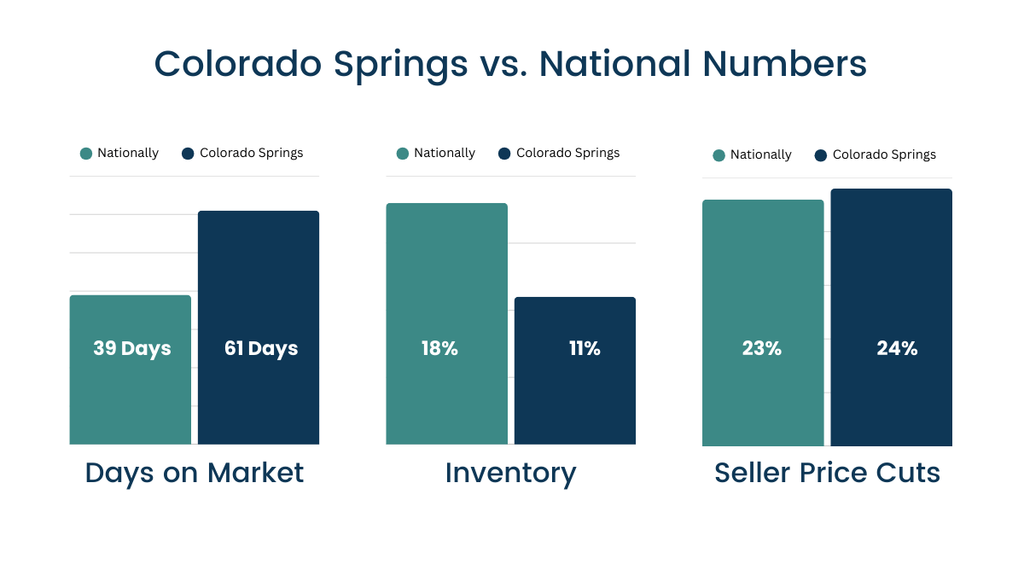 This isn't a crash—it's a correction. El Paso County is adjusting in line with national trends while maintaining relatively stronger fundamentals, but homes are taking longer to sell here, which fundamentally changes your selling strategy.
Key Data Points Every Home Seller Should Know
Let's get specific about what's actually happening with your home's value and your realistic expectations in today's market.What This Means for Your Home's Value
Current MLS data shows median prices at $469,950 for single-family and patio homes—down 5.6% from last year. El Paso County property values have declined moderately, reflecting the broader market correction. We're currently at 3.4 months of supply—approaching the balanced market threshold of 4-6 months while remaining tighter than the 4.2-month national average.
Sales Reality and Pricing Pressure
Homes are averaging 1.5% below asking price—essentially matching the national average of 1.6% below asking. This suggests El Paso County sellers who price competitively from the start are still achieving strong results. Multiple offers are now rare. Redfin characterizes Colorado Springs as "somewhat competitive" with a score of just 54 out of 100—a dramatic shift from the bidding wars of 2021-2022.What This Means for Your Strategy
Let's be direct: El Paso County operates as a soft seller's market by supply metrics (3.4 months vs. 4.2 nationally), though buyer behavior suggests balanced conditions. With 11% less inventory per capita than the national average, our market maintains fundamental strength despite higher prices creating buyer selectivity. In this market, you need to price competitively from day one, prepare for negotiation, and understand that your home's condition and presentation matter more than ever. The good news? This isn't a crisis market. Homes are still selling—just not as quickly, and not at the prices many sellers hoped for. With 3.4 months of inventory, we're still closer to a seller's market (under 4 months) than a true buyer's market (over 6 months), and we maintain significantly tighter supply than the national average.Seasonal Trends - Best Time of Year to Sell in Colorado Springs
Conventional wisdom says list in spring when families shop before the school year ends and curb appeal peaks. But 2025 has fundamentally rewritten this playbook—and the evidence is striking.The Fall Buyer Advantage That Changes Everything
According to realtor.com's September 2025 study, the week of October 12-18 offered buyers a rare "trifecta": 33% more active listings, prices 3.4% below seasonal peaks (about $15,000 in savings), and 31% less competition than peak season.
If fall became the best time for buyers, what does that say about spring for sellers? The traditional advantage—more buyers creating competition and driving prices—has been diluted by an overwhelming surge in inventory. Buyers now shop when they want, not when sellers need them to.
This buyer advantage in fall reveals an important truth for sellers in 2026: the old seasonal rules no longer apply.
Why Spring's "Best Season" May Backfire
Peak season still means more buyers—but in 2026, it also means dramatically more seller competition. Last year's Q2 brought a significant inventory surge in Colorado Springs, and by early summer, sellers were competing through either exceptional condition or aggressive pricing just to get noticed.
Here's the paradox: when everyone follows the same "list in spring" conventional wisdom, competitive edge disappears. Would you rather be one of 2,819 homes on the market right now in January, or one of 4,500+ properties competing in May?
The Strategic Winter/Early Spring Advantage
selling house in winter
Spring Still Has Real Advantages—If You Can Stand Out
The traditional peak season hasn't lost all benefits. Spring brings a genuinely larger buyer pool—families freed by the school year ending and buyers waiting for better weather. In Colorado Springs specifically, military PCS season (May-August) brings an influx from Peterson Space Force Base and Fort Carson, representing about 17% of local employment with genuine urgency and compressed timelines. But here's the catch: With inventory already elevated in winter, spring's traditional surge could bring 4,500+ competing homes. Increased buyer demand may not keep pace with seller supply.The Bottom Line on Timing
The best time to sell in 2026 isn't simply about picking the right season. It's about timing your sale strategically relative to your competition, not the calendar. If you're betting on spring, you're betting the increased buyer pool will more than offset the flood of competing inventory—possible, but not guaranteed given current trends.The Strong Case for Selling Now
Waiting for "better" market conditions may actually cost you more than selling today. Current conditions offer strategic advantages that could disappear by spring. Here are four compelling reasons why now may be your optimal time to sell.Reason 1: Market Reality Favors Action Over Waiting
You're facing manageable competition now—but not for long. With 2,819 homes currently on the market, spring will bring a flood of new listings from sellers waiting for the "best time of year." You're not competing against 2,819 homes in spring—you're potentially competing against 4,500+ properties. Winter buyers shopping now aren't casually browsing—they're serious, motivated purchasers who've weathered higher mortgage rates and committed to buying despite less-than-ideal conditions. Meanwhile, your equity position is still strong. If you purchased before the pandemic, you've likely built $100,000-$200,000+ in equity—that's pricing flexibility that helps you sell faster than your competition. While other sellers cling to optimistic prices and eventually cut them, you can start at a realistic number that attracts serious buyers immediately. If you've owned for 2+ years, the capital gains exclusion protects up to $250,000 ($500,000 for married couples) from federal taxes. The choice: Guaranteed proceeds today, or speculative proceeds six months from now that depend on market conditions improving against current trends?Reason 2: Strategic Timing Creates Advantages
The 61-day timeline works in your favor. List in January or early February, and you'll close before spring competition arrives. Then purchase your next home in spring when inventory is higher and you'll have more options as a buyer. Avoid the price cut cycle. Sellers who list optimistically in spring wait for offers that don't materialize, reduce their price after three weeks, reduce again after six weeks, and finally accept an offer 5-7% below their original asking price after two months of stress. With 23.5% of local sellers cutting prices (vs. 39% nationally), El Paso County sellers are holding firm. However, the market is sending a clear signal: Price right from the start, and you sell while others spend spring chasing the market down.Reason 3: Higher Rates Mean Serious Buyers
Quality over quantity. Yes, mortgage rates around 7% have reduced the buyer pool. But higher rates have filtered out casual shoppers, marginally qualified buyers, and speculators. What remains is a smaller but far more serious group. Winter buyers are motivated by job relocations, family changes, or genuine housing needs that can't wait. These committed buyers have done their financial homework, they're qualified, and they're ready to close. The irony: Lower rates would bring more buyer competition—but also exponentially more seller competition. Every homeowner with a 3% mortgage who's been locked in place would suddenly consider selling. Higher rates actually work in your favor if you're willing to sell now.Reason 4: Personal Circumstances Trump Perfect Timing
The real question: Not "Is this the best time to sell?" but "Is this the right time for me to sell?" Job relocations, family size changes, health issues, financial circumstances, divorce, estate settlements—these create their own timelines that don't care about real estate seasonality. The cost of waiting is real:- Mortgage payments: $15,000-$18,000 over six months
- Property taxes, insurance, utilities, maintenance: $5,000-$7,000
- Total carrying costs: $20,000-$25,000
- Plus: Life goals on hold, stress, potential for major repairs
Reasons to Wait
While the case for selling now is compelling, waiting makes genuine sense in certain situations. Here's when patience serves you better than immediate action.When Waiting Makes Sense
You need time for strategic reasons: ✅ Underwater on your mortgage – Rare in Colorado Springs, but recent buyers (2021-2022 peaks) may need time to build equity ✅ Mid-renovation – Finish the project rather than list a half-completed mess ✅ Approaching two-year ownership – Wait a few months to qualify for capital gains exclusion (saves tens of thousands in taxes) ✅ Personal circumstances unsettled – Don't know where you're moving or haven't secured your next home yet Real example: Your home needs $30,000 in updates. Spending 3 months to complete them properly—finishing the basement, updating the kitchen—could add $50,000+ to your sale price. Rushing to market with half-finished work costs you more than waiting.Spring Market Advantages
Spring still offers real benefits:- Genuinely larger buyer pool (families, military PCS transfers, weather-motivated buyers)
- Peak curb appeal with mature landscaping and longer daylight hours
- Buyer optimism translates to stronger offers and fewer inspection hassles
Preparing to Sell
Use winter productively if your home needs work:- Deep cleaning, decluttering, painting, staging
- Strategic repairs that increase sale price more than their cost
- Financial preparation (saving for moving costs, next down payment, carrying costs)
The Key Question
Are you waiting for strategic reasons, or simply hoping the market will improve? One is smart planning. The other is speculation.Should You Sell Now or Wait? Your Decision Checklist
Answer these 5 critical questions honestly: ☐ Do I have a compelling personal reason to move? Job relocation, family changes, health issues, lifestyle needs, or simply ready for change? ☐ Is my home in sellable condition right now? Show-ready today, or needs 2-3 months of repairs, updates, and deep cleaning? ☐ Can I financially handle selling in current conditions? Enough equity to price competitively? Savings for moving costs and next home? ☐ Am I waiting for market reasons or personal reasons? Honest answer: Hoping for better prices, or truly not ready to move yet? ☐ What's my backup plan if I wait and the market softens further? Specific trigger points, or just hoping conditions improve?Run Your Numbers (Don't Skip This)
☐ Calculate estimated net proceeds: Current price minus mortgage payoff, closing costs, repairs = ? ☐ Calculate 6-month carrying costs: Mortgage + taxes + insurance + utilities + maintenance = $______ ☐ Compare: Net proceeds today vs. net proceeds in 6 months (Don't forget: Would need 5%+ appreciation just to break even on carrying costs) ☐ Factor in your next housing plan: Buying locally? Relocating? Renting temporarily? Each affects timing.Count the Opportunity Cost
☐ Life goals on hold while waiting ☐ Monthly stress of maintaining a home you're ready to leave ☐ Risk that market doesn't cooperate with your timeline: Spring could bring 4,500+ competing listings, more price cutsWhen You Need Professional Input
☐ Get local market analysis from an experienced agent: What YOUR home can sell for TODAY, not Zillow's estimate (Springs Homes offers free, no-obligation valuations with metro district expertise) ☐ Consult financial advisor: Capital gains implications, tax strategy, investment timing ☐ Remember: Data beats speculation. Your decision should be based on current market facts + your personal circumstances, not hopes about what might happen in 6 monthsYour Decision:
Based on this checklist, I'm leaning toward: ☐ Selling Now - Personal circumstances + current market conditions align ☐ Waiting Until Spring - Need preparation time + betting on seasonal advantage ☐ Waiting Longer - Not ready personally, regardless of market Next Step:Making Your Decision
The Reality Check
Perfect timing is impossible to predict. If economists with sophisticated models still get forecasts wrong, why expect to? The right decision isn't about perfect market timing. It's about finding where "good enough" market conditions align with your personal readiness. Current El Paso County conditions are workable—not ideal for sellers, but far from crisis territory.Your Next Steps If You Decide to Sell
Get accurate information. Schedule a professional home valuation with an experienced local agent who understands current market conditions—not a Zillow estimate, but actual comparative market analysis. Springs Homes specializes in realistic valuations, especially for metro district properties where online estimates are notoriously unreliable. Interview agents strategically. Look for honesty about current market realities rather than unrealistic promises. Ask about their strategy for the current market, experience with your property type, and marketing plan. Create a realistic timeline. With 61 days average days on market, plan for 10-12 weeks from listing to closing. Factor in 2-3 weeks of preparation. Prepare strategically. Focus on high-impact, low-cost improvements: deep cleaning, decluttering, minor repairs, curb appeal basics. Save major renovations for the next owner.Your Next Steps If You Decide to Wait
Set specific trigger points—not vague goals. ❌ Bad trigger: "When the market improves" ✅ Good trigger: "If inventory drops below 2,500 homes by April 1, I'll list. If not, I'm listing anyway because my family needs the space" Use time productively:- Complete postponed repairs
- Declutter systematically (one room per weekend)
- Save aggressively for moving costs
- Research your next neighborhood
- Track days on market in your neighborhood monthly
- Watch percentage of listings with price cuts
- Note inventory levels
- Set up Google alerts for "Colorado Springs housing market"
Frequently Asked Questions
Is now a good time to sell in Colorado Springs?
For sellers with strong equity, genuine reasons to move, and realistic pricing expectations, the current market is workable. Homes are selling in 61 days on average with proper pricing.Should I wait until spring to sell my house?
Spring brings more buyers but also significantly more competing sellers. If you can list now or in early spring (before May), you'll face less competition.How long does it take to sell a house in El Paso County right now?
Currently, 61 days on average, compared to 53 days nationally. Homes priced competitively from day one sell faster than those that start high and cut prices.What percentage of homes are selling below asking price?
El Paso County homes are typically selling 1.5% below listing price—essentially matching the 1.6% national average.Will El Paso County home prices go up in 2026?
Current MLS data shows median prices at $469,950 for single-family and patio homes—down 5.6% from last year. With 3.4 months of inventory and prices already correcting, significant near-term appreciation is unlikely.Take Your Next Step
Statistics or seasonal trends don't determine the best time to sell. It's when your life circumstances, financial readiness, and acceptable market conditions align. The current reality:- El Paso County isn't 2021-2022, but it's workable
- Homes are selling with realistic pricing and strong presentation
- For sellers with solid equity and genuine reasons to move, this market is absolutely viable
Ready to Make an Informed Decision?
Get a free, no-obligation home valuation from Springs Homes. We'll provide honest analysis of your home's current market value (not Zillow's estimate), discuss strategic pricing for current conditions, and help you understand whether now or spring makes more sense for your specific situation. Contact Springs Homes today for your complimentary market analysis and let's discuss your best path forward.Data sources: Pikes Peak MLS Monthly Sales Activity Report, Listing and Sales Summary, and Active/Sold Listing Analysis (December 2025); Redfin National Housing Market Data; Realtor.com Market Trends
Check out this article next